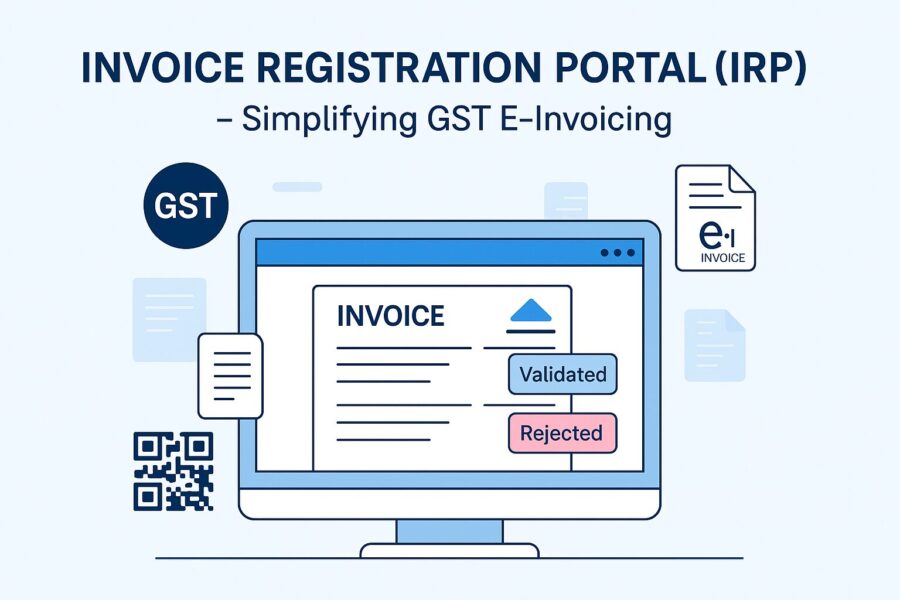
Invoice Registration Portal (IRP) is the backbone of the GST e-invoicing system. It helps businesses generate and validate invoices digitally. Introduced to curb tax evasion, IRP improves transparency and compliance. Therefore, understanding it is crucial for GST-registered taxpayers.
What Is Invoice Registration Portal (IRP)?
Invoice Registration Portal (IRP) in India is an online platform authorised by the GST Network. Its role is to validate electronic invoices under GST. Once validated, the portal issues a unique Invoice Reference Number (IRN). IRP is central to GST e-invoicing, digital invoicing, and tax compliance. In addition, it integrates smoothly with GST returns and e-way bills.
For example, when a business creates an invoice in its accounting software, it uploads key details to IRP. The portal checks duplication and authenticity. However, IRP does not store invoices permanently. It only registers and returns them with a QR code.
How Invoice Registration Portal (IRP) Works:
Invoice Registration Portal (IRP) in India follows a simple, structured flow. First, businesses generate invoices in their own ERP or billing system. Then, they upload invoice data in JSON format to IRP. Next, IRP validates the details like GSTIN, invoice number, and date. If valid, it generates the IRN and digitally signs the invoice. Therefore, the invoice becomes legally valid.
Moreover, IRP shares invoice data with the GST portal automatically. This reduces manual data entry. E-way bill details are also pre-filled, saving time. According to the GST Council, businesses with turnover above ₹5 crore must follow e-invoicing norms (CBIC). This has brought millions of invoices under IRP since rollout.
Eligibility and Mandate for Businesses:
Understanding Invoice Registration Portal (IRP) also means knowing who must use it. The GST Council introduced e-invoicing in October 2020 to standardise invoice reporting for larger businesses. Initially, only companies with an annual aggregate turnover above Rs. 500 crore were required to comply. Since then, the mandate has gradually expanded to include businesses with lower turnover thresholds, such as Rs. 10 crore and above. Under the current system:
- Eligible taxpayers must report invoices to any authorised IRP.
- Multiple portals (such as government and private providers) are available, giving flexibility to taxpayers.
- Even if your business uses accounting software or ERP systems, the invoice must be reported to an IRP to get an IRN.
In addition to legal compliance, using the IRP helps businesses automate workflows, reduce manual entry errors and strengthen audit trails.
Benefits of IRP for Businesses:
Invoice Registration Portal (IRP) in India offers several benefits to businesses. First, it reduces invoice fraud and duplication. Each invoice gets a unique IRN, ensuring authenticity. Moreover, it simplifies GST return filing. Since invoice data flows directly to GSTR-1, errors reduce significantly. Therefore, compliance becomes easier and faster.
Another benefit is better cash flow management. Clean invoice data helps in quicker reconciliations. For businesses seeking funds, accurate invoices support credibility. In addition, automation lowers operational costs. Businesses save time spent on manual checks and correction.
Conclusion:
Invoice Registration Portal (IRP) plays a vital role in strengthening the GST framework. It simplifies invoicing, improves compliance, and reduces fraud risks. Moreover, it helps businesses save time through automation and seamless data flow. As India moves toward a fully digital tax ecosystem, IRP will become even more important for sustainable business growth and transparency. Explore more GST insights now!
– Ketaki Dandekar (Team Arthology)
Read more about Invoice Registration Portal (IRP) here – https://cleartax.in/irp